
10-Year Infrastructure Capital Plan
The 10 year capital plan for infrastructure projects within the roadway is available as a map and table. The City operates and maintains approximately $1.2 billion worth of assets which require continual rehabilitation and replacement. This clear long term plan will ensure the efficient use of available budgets and maximize asset lifecycles. All streets will be reconstructed using a Complete Streets approach to create attractive and livable streets.
The plan was developed using in-house staff expertise, condition assessment data, risk assessments, and various studies. Projects are prioritized based on a number of factors including risk, most effective timing of rehabilitation to maximize lifecycle, areas with combined sewers, pipe upsizing required for upstream development, water quality improvements, etc. Selecting the projects is complicated by the fact that there are multiple assets (i.e. watermain, sewers, road, streetlights, etc.) within the same roadway that all have varying life expectancies and rehabilitation or replacement needs.
The map includes the pavement condition map and the watermain and sanitary sewer risk maps. The risk is based on the likelihood of failure (i.e. age, material, etc.) and the consequence of failure (i.e. larger pipes impact more users, break on major road disrupts more traffic, etc.).
Road Construction Selection and Prioritization FAQ
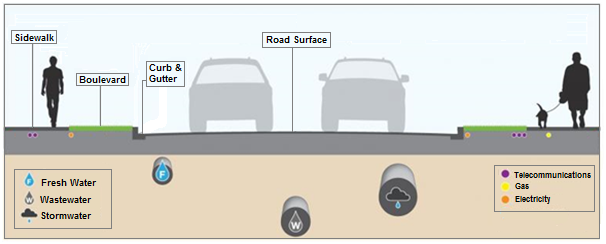
When you look at a street, you see the surface—roads, sidewalks, and curbs. However, below the surface there is critical infrastructure such as watermains, sanitary and storm sewers, gas, and utilities.
Each of these systems has a different lifespan. The City regularly inspects and rates each asset to determine its condition, level of risk, and remaining service life. Streets are then prioritized based on the combined condition of all underground and surface infrastructure.
In some cases, difficult trade-offs are required—for example, deciding whether to reconstruct a road with good pavement but failing sewers, or one with fair pavement but a deteriorating watermain. Additional factors such as safety risk, environmental impact, combined sewers, and future growth needs are also considered.
This process is similar to household decision-making, where multiple necessary repairs must be prioritized within a limited budget.
The City maintains approximately 437 lane kilometres of roads (where 1 kilometre of a 4-lane road equals 4 lane kilometres), with an estimated replacement value of $301 million.
To keep the road network in a sustainable state, the City should be investing approximately $6 to $9 million annually in road rehabilitation and replacement. For more information, refer to the Road Asset Report Card.
Road reconstruction decisions are guided by a long-term asset management plan and multiple technical factors. A street may be selected for reconstruction even if it appears in better condition because:
- Preventative work provides better long-term value
- Underground infrastructure is in poorer condition
- There is higher risk of failure or service disruption
- The project can be coordinated with other utility work
- The other street is scheduled for future reconstruction
- Upgrades are needed to support growth or redevelopment
Not all roads serve the same purpose. Major roads such as arterial streets carry higher traffic volumes and experience more wear and tear, requiring more frequent maintenance and resurfacing.
Local residential streets generally carry less traffic and may not require resurfacing as often, even if they appear older.
Yes. The City evaluates the most cost-effective construction approach for each project.
Where possible, trenchless technologies are used. These methods allow underground infrastructure to be repaired or replaced without fully excavating the roadway. For example:
- Sewers can be repaired through existing manholes
- Watermain work may only require small access pits
Trenchless methods can reduce costs, shorten timelines, and significantly minimize disruption to residents and traffic.
Each project is reviewed to determine the most efficient construction schedule. While contractors are required to meet project deadlines and may face penalties for delays, work hours are balanced with cost, safety, and community impact.
Night or 24/7 construction is generally avoided because it:
- Increases construction costs
- Creates higher safety risks
- Causes noise impacts for residents and businesses
- May still not significantly shorten overall timelines
However, overnight work may be used for short-duration, high-impact activities such as intersection paving.
Ultimately, the City must balance project speed, cost efficiency, and community impacts to ensure infrastructure is replaced responsibly and affordably.